3D Fabric and Clothing Design Software in 2026: 6 Leading Tools for Characters, VFX, and Apparel
Compare the 6 leading 3D fabric and clothing creation tools in 2026. Evaluate 2D pattern tailoring, dynamic physics solvers, sculpting workflows, engine export, and pricing across games, VFX, and fashion.
Key takeaways
- Construction paradigm dictates production speed and form: Pattern-based tools construct clothing from 2D panels sewn around an avatar, while polygonal modeling and dynamic sculpting shape garments directly on 3D meshes using vertex deformation and digital clay brushes.
- Pipeline role defines software selection: Entertainment and visual effects pipelines rely on dedicated garment-foundation tools to generate base silhouettes before downstream sculpting and DCC handoffs, whereas apparel manufacturing CAD packages prioritize technical grading, factory tech packs, and enterprise PLM integration.
- Solver mechanics vary by technical objective: Dedicated simulation tools resolve tensile and shear forces across sewn panels, whereas open-source DCC environments like Blender implement mesh-based cloth dynamics nodes and spring constraints.
- Tool evaluation scope: This comparison evaluates Marvelous Designer, CLO, Blender, and Maxon ZBrush. SideFX Houdini (Vellum) was included in the initial assessment scope, but due to a lack of verified comparative evidence in the current record, it is categorized as uncovered and excluded from ranked evaluations.
Core garment creation methods: 2D pattern drafting versus 3D modeling and sculpting
Digital fabric authoring in 2026 splits into two primary methodologies: tailored 2D flat-pattern drafting assembled in a 3D simulation space, and direct 3D surface manipulation using polygon modeling, simulation modifiers, or dynamic digital clay sculpting.
- 1. Draft/edit 2D pattern pieces
- 2. Define seam arrangements
- 3. Drape and simulate on avatar
- → Natural tension, seams, and fit
- 1. Generate base mesh or clay volume
- 2. Apply modifier constraints/brushes
- 3. Deform and sculpt folds
- → Direct control over micro-topology
Pattern-based garment construction
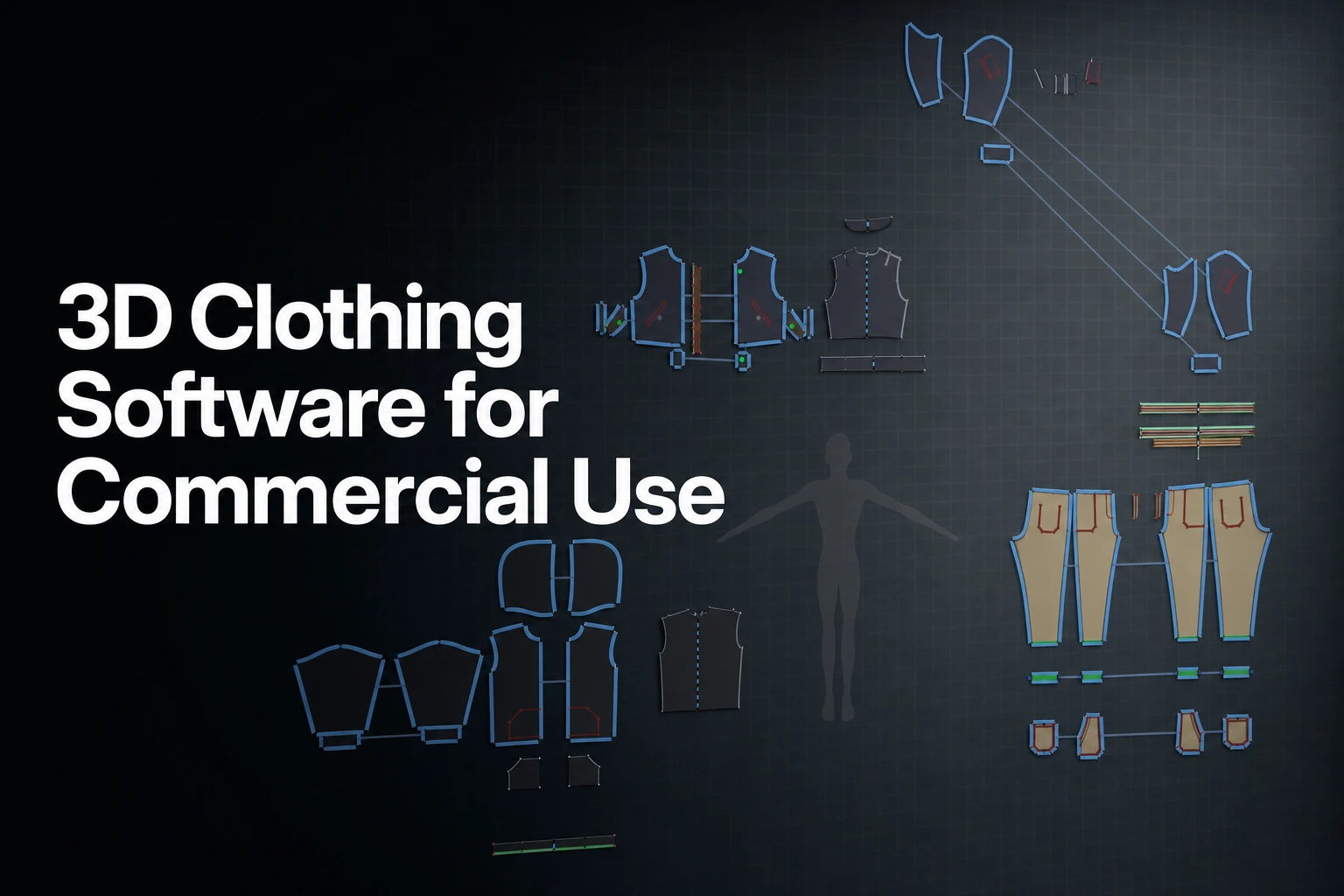
Pattern-based tools replicate physical tailoring. Garments are authored by creating or importing flat 2D pattern shapes, establishing seam connections between corresponding edges, arranging those panels in 3D space around an avatar, and calculating the resulting drape through physical simulation.
- Marvelous Designer: Built specifically for entertainment, games, VFX, and character art pipelines. Users draft or modify 2D pattern pieces, sew them together, arrange them around a target character avatar, and simulate natural draping, fold formation, and layering in 3D space. This creates an accurate foundation of primary tension lines, seam pulls, and natural fabric settling.
- CLO: Shares underlying pattern simulation principles with Marvelous Designer but orients its interface toward apparel development. According to the CLO Technical Fashion Design Software Guide, the software connects 2D pattern editing directly with real-time 3D fit evaluation. Designers use the Pattern Drafter or Edit Points of Measure (POM) tools to retain parametric relationships across sizing changes. The CLO 2D/3D CAD Pattern Making Guide notes that technical designers can grade full size runs from size tables using incremental or total measurement values.
Polymodeling and dynamic sculpting
Direct surface modeling bypasses sewing patterns entirely, shaping fabric directly on 3D geometry using mesh modifiers, physical constraints, or brush-based sculpting tools.
- Blender: Uses mesh-level dynamics and vertex modifiers. The Blender Cloth Dynamics Documentation explains that Blender’s cloth system uses mesh geometry as a rest shape to generate stretching and bending resistance forces, driven by an XPBD solver node within Geometry Nodes. For seam-like behavior, the Blender Shape Documentation details how sewing springs (edges without attached polygonal faces) pull separated vertices together across a mesh. Furthermore, Blender’s Dynamic Mesh settings allow shape keys or skeletal armatures to animate the rest shape continuously while the physics solver handles secondary motion.
- Maxon ZBrush: Focuses on digital sculpting freedom rather than dynamic cloth simulation. According to Maxon ZBrush, artists manipulate surfaces using more than 200 proprietary brushes, treating polygon volumes like digital clay. With tools like ZModeler, Live Boolean, dynamic remeshing, and specialized drapery or inflation brushes, character artists can sculpt hard-surface armor, thick leather, or stylized cloth folds directly onto character geometry without establishing flat pattern boundaries.
Comprehensive comparison of 3D fabric and garment software
The following table summarizes the primary construction approaches, simulation focus, pipeline orientation, supported exports, and licensing models across all evaluated tools.
| Software | Primary Authoring Paradigm | Simulation Solver / Dynamics | Target Pipeline | Primary Outputs & Deliverables | Commercial Licensing Model |
|---|---|---|---|---|---|
| Marvelous Designer | 2D pattern drafting and seam assembly | 3D physical cloth simulation | Games, VFX, 3D character art, animation | Supported downstream DCC, sculpting, texturing, and game engine export workflows | Contact vendor for enterprise tier pricing |
| CLO | 2D parametric apparel CAD and 3D draping | Physical fabric simulation with strain and stretch mapping | Fashion design, apparel product development, virtual showrooms | DXF-AAMA, DXF-ASTM, Standard DXF, structured BOMs, CLO-SET cloud assets, marker layouts | Starting from ~$50/mo or ~$450/year as of 2026 (excluding tax/VAT); contact vendor for enterprise tier pricing |
| Blender | 3D mesh modeling, modifier springs, and sculpting | XPBD solver node cloth dynamics and cloth simulation modifiers | Generalist 3D animation, indie games, visual effects | Native .blend project files, standard DCC geometry via internal pipeline | Free and Open Source (GNU GPL) for commercial and educational use |
| Maxon ZBrush | Direct 3D digital clay sculpting and low-poly modeling | Brush-based manual folding, inflation, and drapery brushes | Character art, concept sculpts, film/game asset production | Standard 3D geometry formats, image texture maps, GoZ live DCC bridge | ~$399.00/year per license as of 2026 (desktop and iPad dual-platform); MyMaxon EULA registration |
| SideFX Houdini (Vellum) | No comparative evidence admitted | No comparative evidence admitted | VFX, procedural pipelines (uncovered) | No comparative evidence admitted | No comparative evidence admitted |
Character art and entertainment pipelines: garment foundation and downstream handoffs
In entertainment production, including video games, feature animation, visual effects, and cinematics, fabric authoring follows a multi-stage handoff.
Garment foundation authoring
For digital costumes, starting with pattern-based tailoring ensures that cloth folds form along physically accurate structural stress lines. In Marvelous Designer, artists draft the true anatomy of a garment, such as collars, sleeves, yokes, and inseams, before sewing them around the character model. This simulation generates the primary silhouette and major draping behavior that would naturally occur when tailored fabric rests on an underlying anatomy.
Because Marvelous Designer is designed as a garment-foundation tool within broader digital content creation pipelines, the resulting simulated garments can transition directly into downstream DCC, sculpting, texturing, animation, game, or VFX environments through supported export workflows.
Downstream detailing and sculpting
Once the primary garment structure is resolved, assets often move into sculpting or generalist DCC packages for secondary and tertiary surface treatment:
- In Maxon ZBrush, artists can import base geometry and refine it using more than 200 brushes to add micro-creasing, surface weathering, edge tears, or stylized forms. ZBrush includes GoZ bridges to send geometry back and forth to applications like Cinema 4D, while PolyPaint and UV Master allow texturing and coordinate layout directly on sculpted volumes.
- In Blender, generalists can use extensive modeling, multi-resolution modifiers using Pixar's OpenSubdiv, and built-in sculpting tools reported on the Blender Developers Blog to refine geometry, establish character skinning, and manage project dependencies.
Apparel design and physical manufacturing: technical CAD workflows
While entertainment software focuses on visual realism and asset handoff for animation, fashion CAD packages emphasize dimensional precision, manufacturing documentation, and supply-chain integration.
CLO apparel CAD & manufacturing pipeline
- Parametric Pattern Drafter
- Multi-size grading tables
- Marker nesting & fabric yield
- DXF-AAMA / DXF-ASTM export
- Enterprise PLM / CLO-SET sync
CLO apparel development
As documented in the CLO 2D/3D CAD Pattern Making Guide, CLO provides a dedicated environment for pattern drafting, multi-size grading, and cut-room preparation:
- Interoperability and cutting rooms: CLO exports 2D patterns in AAMA DXF, ASTM DXF, and Standard DXF formats, allowing technical designers to include grading data or export active sample sizes for physical cutting tables.
- Yield and consumption calculations: According to the CLO Technical Fashion Design Software Guide, native marker-making and auto-nesting (Print Layout mode) calculate fabric utilization and yield directly within the application.
- Enterprise data exchange: CLO integrates with CLO-SET for digital asset distribution and provides PLM plug-in connectors that sync colorways, trim data, and 3D assets directly into enterprise product lifecycle management databases.
Fabric simulation and mechanical properties
Simulating realistic cloth requires calculating how material structures resist stretching, shearing, and bending under gravity and avatar collision.
| Property | Physical Behavior in Simulation |
|---|---|
| Tensile Stiffness | Resistance to stretching along warp and weft axes |
| Shear Resistance | Resistance to diagonal distortion across yarn grains |
| Bending Stiffness | Resistance to flexing (controls wrinkle sharpness) |
| Internal Damping | Energy dissipation rate reducing erratic oscillation |
Note: Comparative benchmarking across all solver engines is insufficient in the admitted record; the following sections document specific solver properties verified within each application's official documentation.
CLO fit analysis and material metrics
In CLO, physical fabric properties are evaluated through visual Fit Maps. The Strain Map manual describes how Fabric Mode calculates wearable stretch limits based on laboratory-tested elongation limits, highlighting points of excessive mechanical pressure. For knitted materials, the CLO 2D/3D CAD Pattern Making Guide documents the Knit Swatch Editor, which lets designers adjust technical textile parameters including wales, courses, yarn thickness, and machine gauge.
Blender cloth dynamics and modifier physics
According to the Blender Physical Properties Documentation, Blender's cloth physics system parameterizes mechanical behaviors into distinct stiffness and damping controls:
- Tension: Controls material resistance to stretching.
- Shear: Controls material resistance to diagonal shearing forces.
- Bending: Sets the wrinkle coefficient, where higher values produce broader, stiffer folds.
- Damping: Governs energy loss across tension and bending behaviors, while linear damping emulates medium drag.
- Internal Springs: Virtual springs that connect interior mesh vertices to give volume to cushions or multi-layer surfaces.
The Blender Cloth Dynamics Documentation notes that its Geometry Nodes cloth dynamics feature uses an XPBD solver node to calculate structural constraints, though it cautions that this node-based solver is experimental and currently lacks built-in self-collision handling.
Architectural visualization and soft furnishings workflows
Beyond character costumes, digital fabric simulation is widely used in architectural visualization for authoring soft furnishings, including duvets, pillows, draped curtains, and upholstered furniture.
- Bedding and mattress covers: Draping sheets and duvets requires simulating large continuous fabric sheets settling over bed frames and pillows. In Marvelous Designer, authoring bedspreads as sewn rectangular pattern panels allows realistic gathering, natural gravity sagging, and corner pleating across collision geometry.
- Cushions and pillows: Pattern-based workflows sew top and bottom fabric panels together and simulate the assembled pieces around collision geometry. In Blender, artists achieve structural volume by enabling the Internal Springs option in the cloth physical properties panel, which generates structural tension across interior vertices to maintain volume.
- Curtains and gathered drapes: Curtains rely on high vertical shear resistance and targeted gathering. In pattern-based tools, drafting wide 2D panels and sewing seam boundaries allows fabric to simulate and settle naturally, producing vertical pleats that cascade down to floor colliders.
Commercial licensing structures and studio adoption
Selecting a garment design platform requires balancing technical capabilities against software licensing models, operating system support, and team scaling costs.
| Tool | Licensing Structure & Pricing Scope |
|---|---|
| Marvelous Designer | Contact vendor for enterprise tier pricing |
| CLO | Individual subscription starting from ~$50/mo or ~$450/year as of 2026; contact vendor for enterprise |
| Maxon ZBrush | Annual subscription ~$399.00/year per license as of 2026 (desktop & iPad dual-platform) |
| Blender | Free and Open Source (GNU GPL); Commercial and educational use permitted |
Commercial tiers and vendor licensing
- Blender: According to the Blender FAQ and About Blender, Blender is distributed as free, open-source software under the GNU General Public License (GPL). Artists and studios own full copyright over all
.blendproject outputs and are free to use the software commercially without subscription fees. Organizations may modify the source code internally, provided modified versions distributed externally also publish their source under the GPL. On the Blender Download Page, Blender warns that experimental builds contain untested features that are unstable and not recommended for production environments. - CLO: As reported on the CLO Technical Fashion Design Software Guide, individual subscriptions start from ~$50/month or ~$450/year as of 2026 following a 14-day trial (excluding taxes and VAT). For multi-user studio deployments and enterprise apparel brand management, teams must contact vendor for enterprise tier pricing.
- Maxon ZBrush: As documented on Maxon ZBrush, commercial licensing is available at ~$399.00/year per license as of 2026. Licensing operates under MyMaxon account registration and EULA terms, providing dual-platform access to run the software on desktop and iPad environments simultaneously.
- Marvelous Designer: Contact vendor for enterprise tier pricing.
FAQS
Frequently asked questions
What is the difference between pattern-based clothing software and 3D sculpting tools?
Pattern-based tools like Marvelous Designer and CLO construct garments by drafting flat 2D pattern panels and stitching them together around an avatar, allowing physical simulation to determine realistic fold structures, seam tension, and fabric drape. Digital sculpting programs like Maxon ZBrush operate directly on 3D polygonal geometry using clay-like brushes, allowing artists to manually mold folds, inflate volumes, and sculpt surface micro-details without defining pattern seams.
Can CLO be used for entertainment and game pipelines?
While CLO can export 3D geometry, its core feature set is built for physical apparel manufacturing. It prioritizes measurement-driven grading, ASTM/AAMA DXF exports, factory tech packs, marker layout nesting, and enterprise PLM integration. For entertainment, games, and VFX pipelines, Marvelous Designer is designed specifically to serve as the garment-foundation stage for digital character workflows.
Is Blender capable of complete garment authoring without third-party software?
Blender includes built-in cloth simulation modifiers, an experimental Geometry Nodes XPBD cloth dynamics solver, sewing springs, and a comprehensive digital sculpting toolset. Artists can model garment meshes, define virtual sewing edges, and simulate cloth dynamics directly in Blender. However, official Blender documentation notes that its Geometry Nodes cloth dynamics feature is experimental and currently lacks built-in self-collision handling.
How do physical fabric properties affect 3D cloth simulation?
Fabric physical properties, including tensile stiffness, shear resistance, bending stiffness, and internal damping, dictate how cloth deforms under stress. Tensile stiffness controls resistance to stretching along yarn directions, shear resistance governs diagonal distortion, bending stiffness dictates whether wrinkles are sharp or broad, and damping controls how rapidly motion dissipates. Software like CLO visualizes these forces using strain and stress maps, while Blender exposes these controls through physical stiffness and damping parameters.
Which software should architectural visualizers use for soft furnishings?
Both pattern-based simulation and mesh-based modifiers are used in architectural visualization. Pattern-based workflows in Marvelous Designer allow visualizers to sew and drape complex multi-panel duvets, gathered curtains, and upholstered furniture with natural physical settling. Alternatively, generalist 3D tools like Blender can simulate cushions and pillows by using cloth modifiers configured with internal springs to maintain volumetric inflation.
Next steps
To explore pattern-based garment construction for entertainment, characters, and VFX workflows, try Marvelous Designer or consult the Marvelous Designer Manual for comprehensive documentation on 2D pattern drafting, seam assembly, and pipeline integration.
Disclaimer: This comparison reflects official vendor documentation available at the time of review. Features, availability, and terms may change; verify current details on each vendor’s official website before making a decision.
Explore 3D Garment Creation with Marvelous Designer
Discover how pattern-based digital tailoring streamlines fabric draping and cloth simulation for game, VFX, and character workflows.
Related reading