Fabric as Storytelling in The Abandoned Orphanage

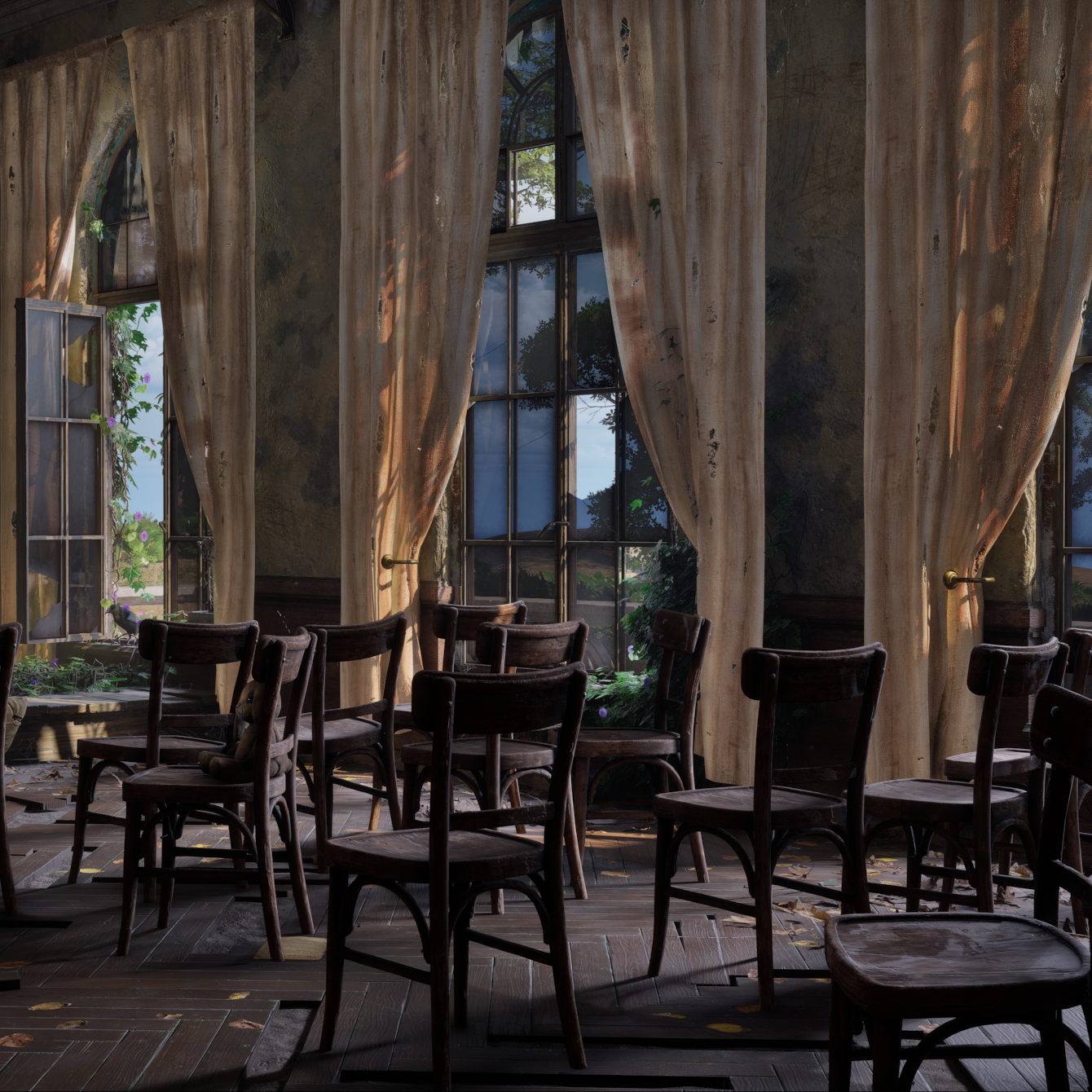

3D Environment Artist Ana Vien shares how Marvelous Designer helped bring believable fabric, aged curtains, and quiet narrative detail into her real-time scene, The Abandoned Orphanage.
Software Used
Blender - Modeling
Marvelous Designer - Cloth Simulation
Substance Painter - Texturing
Unreal Engine - Lighting & Rendering
Could you briefly introduce yourself and your current focus as a 3D Environment Artist?
Hi everyone, my name is Ana, and I'm a 3D Environment Artist. My current focus is level art: building spaces with strong visual composition and storytelling at their core.
Could you introduce The Abandoned Orphanage and share how the idea evolved during production?
At first, the project consisted of a single corridor. It was created for The Rookies: Shadows challenge and featured the ghosts of children. At that stage, the scene only showed subtle signs of abandonment, the passage of time, and complete silence. However, it was still quite unpolished.
I didn't want the orphanage to feel too luxurious or overly dark. Instead, I wanted it to feel mysterious and dangerous.
I spent another month adding a children's bedroom and an assembly hall while improving the environmental storytelling.

The scene includes many narrative details, from children's objects to torn fabrics and overgrown organic forms. How did you decide what to include?
In the bedroom, I tried to show each child's personality through their belongings. Despite their differences, they all shared the same wish: to have a family. On the floor, they created something that looked like a ritual, hoping it would bring them one.
A mysterious organic growth spreads across the ceiling. It represents the grief and tragedy that had built up in the room over the years, slowly spreading throughout the orphanage.
I visually divided the assembly hall into two parts. One side of the stage represents death and decay, while the other represents life. In a way, the stage reflects life itself.

This idea can be seen through the paintings, plants, animals, and music. Tchaikovsky's The Sick Doll perfectly matches the mood of the scene. Many of the sheet music pages are simple piano lessons for children, showing that this room was once a place where they learned and spent time together.
I wanted the curtains to look light and airy while still showing the effects of age and wear. I achieved this without using transparent shaders.
How did Marvelous Designer fit into your workflow for this project, especially when creating believable cloth, fabric, or soft interior elements?
Curtains played an essential role in the visual storytelling. Through fabric, you can convey how deeply abandoned a place is and even hint at the era it belongs to through the cut and style of the cloth.
At the same time, this element brings the scene to life: a gentle sway in the wind, the silhouette of natural folds, and the softness that can be achieved through simulation in Marvelous Designer.

What is your favorite feature or tool to use in Marvelous Designer?
My favorite thing about Marvelous Designer is how naturally everything comes together. You simply run the simulation, and the fabric drapes on its own, creating realistic folds and wrinkles.
I also love being able to add creases by hand, work with sewing patterns just like in real tailoring, and adjust the physical properties of each fabric. One of the biggest advantages is that the UVs stay the same as the original sewing patterns, which makes UV mapping much easier.
Being able to work directly with your own avatar also makes it easy to create custom pieces that fit your project perfectly.
Could you walk us through one of your curtain pipelines, from cloth simulation to the final real-time scene?
Let me walk you through one of the pipelines I used for the curtains, probably the simplest one.
1. Import Avatar
First, I imported an avatar for the cloth simulation. In my case, it was the entire wall module, which let me match the exact dimensions and make sure the curtain interacted correctly with the floor.
2. Base Shape
Then I created a base curtain shape that could be reused and varied later. Saving it as a separate file is a huge time-saver, since it gives you a solid starting point for creating different variations.
3. Shaping, Fabric Settings & Export
Once I was happy with the overall silhouette and design, I exported it as an FBX. I chose not to use baked animation. While Alembic is tempting, it has a noticeable impact on scene performance in Unreal Engine.
In Blender, I checked the scale, UVs, and mesh density, keeping only the geometry necessary to preserve the folds. After all, in a personal project, you're your own boss.
4. Texturing
There are many ways to texture curtains. You can use tiling textures, trim sheets, or unique textures. If you plan to create many different fabric variations, a modular approach also works well.
In this project, I used a mix of all three. Some curtains use unique textures, while others use tiling materials.
5. Import into Unreal Engine
Finally, I imported the curtains into Unreal Engine, set up the materials, and made the final adjustments. I also smoothed some parts of the mesh, since detailed folds on low-poly geometry can sometimes create visible aliasing.
This can be fixed in Blender, ZBrush, or directly in Unreal. The wind effect was added in Unreal Engine to keep everything lightweight and performant.


What was the most challenging part of creating The Abandoned Orphanage, and what advice would you give to artists who want to use Marvelous Designer in environment art?
The biggest challenge was finding the right balance between visual quality and performance.
My biggest piece of advice is not to think of Marvelous Designer as a tool just for making clothes. It's also a powerful tool for environment art.
You can use it to create curtains, tablecloths, bed sheets, carpets, banners, canopies, tents, and many other assets that make a scene feel more realistic and alive. Start with simple objects, and don't be afraid to experiment.


이 작업은 Blender, Substance, UnrealEngine, Environment 등의 기술로 제작되었습니다.
Marvelous Designer로 이와 같은 3D 의상·캐릭터 작업을 직접 만들어볼 수 있습니다.